
- ◆ Pakistan's Trusted DPL Consultancy
DPL License in Pakistan
Complete Licensing & Consultancy Services
Excellent Services provides end-to-end consultancy for the storage of dangerous petroleum products and flammable chemicals in Pakistan. We handle Form D application, all department NOCs (DCO, TMO, Civil Defence, ANF, EPA, DIG), MSDS documentation, storage plan preparation, and annual renewal, one window, one team, one delivered outcome.
What is a Dangerous Petroleum License (DPL)?
A Dangerous Petroleum License (DPL) is the mandatory permit required in Pakistan to store, handle, transport, or sell petroleum products and flammable chemicals above prescribed quantities. It is issued by the Chief Controller of Explosives under the Petroleum Act 1934 and the operational rules of the Petroleum Rules 1937. Whether you run a paint factory, chemical trading firm, pharmaceutical unit, petrol pump, industrial facility, or import business, if you store dangerous petroleum products or hazardous chemicals, DPL licensing is not optional.
Obtaining a DPL license involves multiple government departments, precise technical documentation, engineered storage construction, and coordination with the Department of Explosives. It is a complicated, time-consuming process, which is exactly why businesses across Pakistan trust Excellent Services to handle it end-to-end. See our DPL case studies for real projects we have completed, or read our guide to the explosive rules Pakistan uses for petroleum and chemical storage.
What We Handle for You
From your first consultation to license in hand, and every annual renewal after, Excellent Services covers every stage of the DPL process:
DPL Application & Documentation
- Complete preparation and filing of the Form D application, treasury challan deposit, land or tenancy documents, and proposed storage plan (5 copies), everything the Department of Explosives requires, prepared to specification.
Government NOC Arrangement
- End-to-end NOC processing from every required department, DCO, TMO, Civil Defence, Anti-Narcotics Force, Environmental Protection Agency, and DIG, pursued in parallel to compress the timeline.
Storage Godown Construction
- Construction of DPL-compliant storage godowns to exact Petroleum Rules 1937 specifications, C.C. block walls, RCC columns, sump floor, copper-mesh ventilators, and G.I. sheet doors. First-time inspection pass guaranteed when we build.
MSDS Documentation
- Full 16-section GHS-compliant Material Safety Data Sheets prepared for every chemical on your license, at your product's exact purity percentage, ready for immediate submission to the Explosives Department.
All Department NOCs & Utility Clearances, Handled By Us
A complete DPL application often requires No Objection Certificates from multiple government departments and utility providers, the exact list depends on your location, chemicals, and premises. Each authority has its own procedure, timeline, and technical requirements. We pursue them in parallel to compress your timeline:
D.C.O
District Coordination Officer, with attested site / location plan
Assistant Commissioner
Local Assistant Commissioner NOC for storage premises & site suitability
T.M.O
Town Municipal Officer, local body clearance for storage premises
Civil Defence
Fire safety, emergency preparedness & evacuation compliance
Fire Brigade
Municipal fire brigade NOC, firefighting readiness at premises
Anti-Narcotics Force
ANF clearance for chemicals with dual-use potential
EPA
Environmental Protection Agency, pollution, discharge & environmental NOC
DIG / Police
Security clearance from the Deputy Inspector General office
K-Electric
Utility clearance for electrical load, flameproof wiring & safety (Karachi)
SSGC / SNGPL
Gas utility clearance, verifies safe distance from gas mains & connections
SITE / Estate Association
Industrial estate association attestation for premises inside SITE / industrial zones
Cantonment Board
Where premises fall within a Cantonment area, mandatory Board NOC
Documents Required by the Department of Explosives
For the grant of a non-bulk storage DPL license, the Department of Explosives requires the following complete document package, all of which we prepare and submit on your behalf:
- Application Form “D” duly filled and signed by the owner
- Treasury challan deposited in federal treasury per chemical quantity
- NOC from District Authority with attested site/location plan
- SITE Association attestation where applicable (Karachi)
- Land ownership documents, title deed / registered sale
- Registered tenancy agreement if premises are rented
- Proposed storage plan, 5 copies to Explosives Dept spec
- MSDS documentation for every chemical to be stored
- Company registration & NTN proof
- Six departmental NOCs (DCO, TMO, Civil Defence, ANF, EPA, DIG)
Free assessment of your business, chemicals, and premises, we identify the correct license form, prepare the documentation strategy, and give you a realistic timeline.
Godown Construction Requirements for DPL
The Department of Explosives inspects every storage godown before granting a DPL license. Construction that does not match the approved plan or the Petroleum Rules 1937 will fail inspection, costing months of rework and lost revenue. Every DPL-compliant storage godown must meet these 10 mandatory conditions:
DPL Storage Godown, Technical Certificate
Petroleum Rules 1937 · Mandatory Conditions
- Walls constructed of C.C. block with RCC columns, no wood used in construction
- Ventilators provided 6 inches above ground level and 1 foot below roof, covered with single copper-wire gauge mesh of 28 linear inches
- Firefighting arrangements per Petroleum Rules 1937, extinguishers, sand buckets, water arrangement
- Smoking not allowed inside the premises, enforced with clear signage
- At least one guard on duty round the clock, fully conversant with fire-fighting techniques
- Storage godown floor with 2 feet 0 inches deep sump for spill containment
- Door of the storage shed angle-iron form of G.I. sheet with outward opening
- No natural gas main exists within a 50-foot radius of the premises
- No use of fire or burner inside the guard/in-charge room for cooking or any other purpose
- Existing industrial shed contains no other dangerous petroleum goods; offices are completely closed / empty of activity
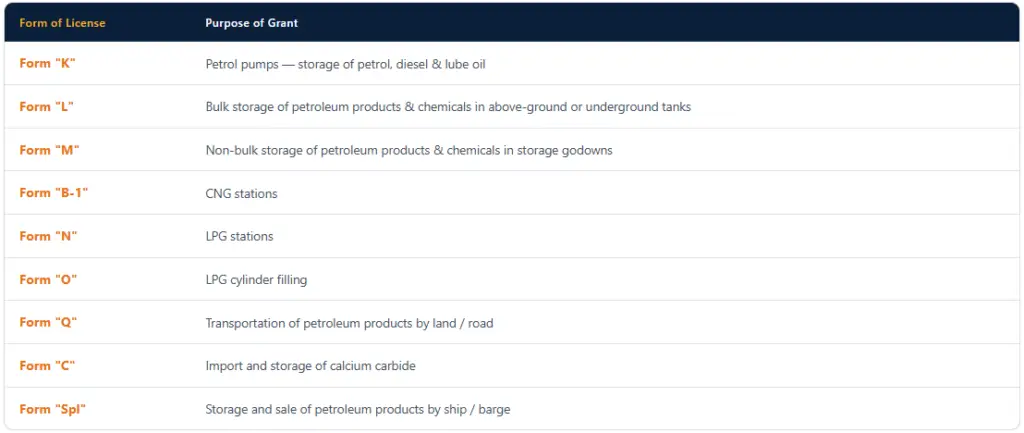
Forms of DPL License in Pakistan
The Department of Explosives issues DPL licenses under different forms depending on the storage type, chemicals, and end use. Identifying the correct form is the first step, the wrong form means an automatic application rejection.
Common Chemicals Requiring a DPL License
DPL licensing covers a wide range of solvents, monomers, acids, fuels, and industrial chemicals. Below are some of the most commonly licensed products across Pakistan’s paint, pharmaceutical, chemical trading, and industrial sectors:
Note: This is a partial list. Excellent Services maintains MSDS documentation for 250+ DPL chemicals, from common solvents like acetone and toluene to specialty monomers, oxidizers, and paint raw materials. See the full DPL chemical list with free MSDS search.
Don’t see your chemical? We license 250+ chemicals, contact us for the full MSDS list.
DPL Application Process, Step by Step
From first call to licensed operations, here is exactly how we deliver your DPL license:
Why Businesses Trust Us for DPL Licensing
One-Window Delivery
Assessment, documentation, construction, NOCs, license, and renewal, one team, one price, one responsibility.
First-Time Inspection Pass
When we construct, we guarantee the inspection outcome. No costly rework, no rejected applications.
Complete Legal Compliance
Every deliverable strictly compliant with Petroleum Act 1934 & Petroleum Rules 1937. Local and national regulations covered.
15+ Years Experience
Deep working relationships with the Department of Explosives, Sindh EPA, Civil Defence, and District Authorities.
200+ Licenses Delivered
From paint manufacturers to pharmaceuticals to chemical importers, every industry, every complexity level.
Renewal Tracking Included
Once licensed, our tracking system handles every annual renewal automatically, before the 1 December deadline, every year.
DPL License FAQs
What is a DPL license and who needs it in Pakistan?
Which NOCs are required for a DPL license?
Six government NOCs are required: DCO (District Coordination Officer), TMO (Town Municipal Officer), Civil Defence, Anti-Narcotics Force (ANF), Environmental Protection Agency (EPA), and DIG. Each department has its own procedure. We arrange all six in parallel to compress the licensing timeline.
How long does it take to get a DPL license in Pakistan?
What is the difference between Form M and Form L?
I don't own storage premises. Can I still get a DPL license?
Get Your DPL License With Zero Hassle
Free assessment · Complete documentation · All 6 NOCs · Construction · License · Renewal tracking, one team, one price, one delivered outcome.