Explosive Department Offices in Pakistan: NEPSA Addresses and Contacts
Explosive department offices in Pakistan: NEPSA head office and regional offices in Lahore, Karachi, Multan, Peshawar...
Read Guide →
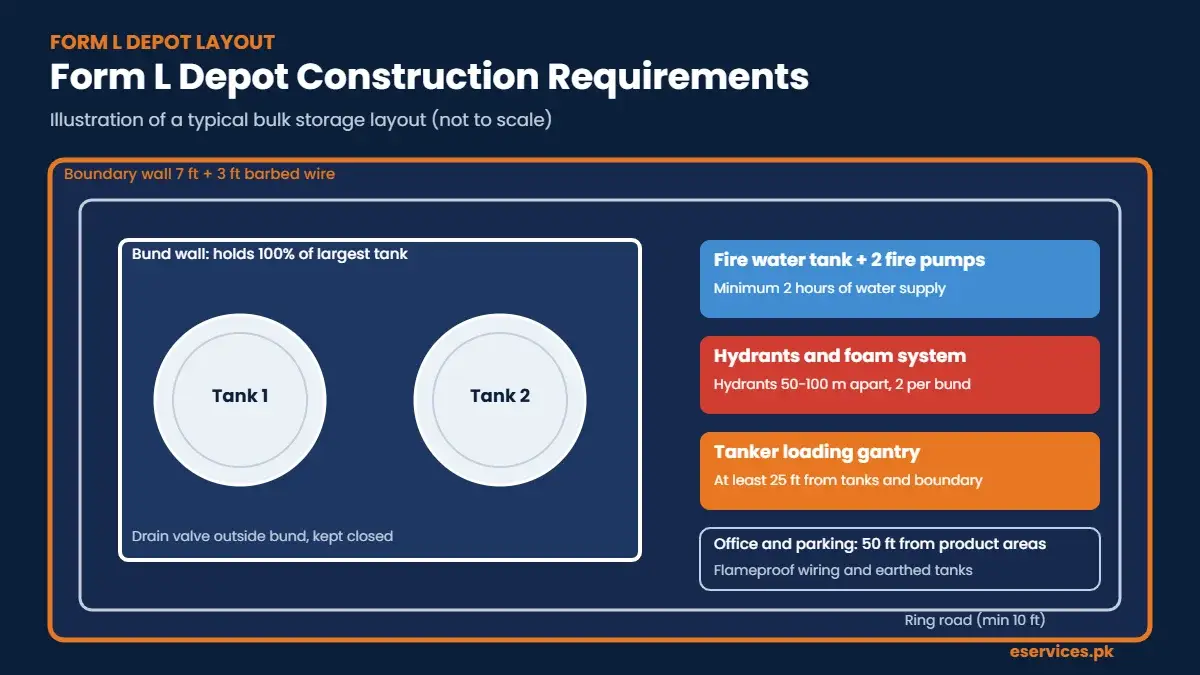
A Form L licence is granted only when your depot or tank farm is built exactly to the drawings approved by NEPSA (formerly the Department of Explosives). This guide explains the Form L depot construction requirements in Pakistan: site layout, tanks, bund walls, fire fighting and electrical safety, with the official rule behind each one.
A Form L licence covers bulk storage of petroleum products and petroleum-based chemicals in fixed tanks, above ground or underground. Under the Petroleum Rules 1937, such premises are an “installation”: a place specially prepared for storing petroleum in bulk. The licensing authority is the National Explosives and Petroleum Safety Agency (NEPSA), the new name of the Department of Explosives under the Ministry of Energy (Petroleum Division).
NEPSA approves your drawings first. You build to them, every tank is tested and an officer inspects the finished site. If anything differs from the approved plan, the licence waits until it is corrected. For oil marketing companies and commercial depots, OGRA also applies its Technical Standards for Depots for the Storage of Petroleum Products (S.R.O. 624(I)/2009), which follow the American NFPA 30 code. The figures in this guide come from these sources.
The rules get stricter as the product gets more flammable. Petroleum is grouped by flash point: Class A (below 23°C, such as petrol), Class B (23°C to 65°C, such as diesel and kerosene) and Class C (65°C to 93°C, such as furnace oil). A petrol depot therefore needs more distance and more fire protection than a furnace oil tank. If you store in drums rather than tanks, see our Form M godown construction requirements instead.
Before You Build
Built to API and NFPA 30
Spill Containment
OGRA Depot Standards
Most depot fires start from a spark, so electrical work is checked closely at inspection. These are the Form L depot construction requirements that are easiest to get wrong:
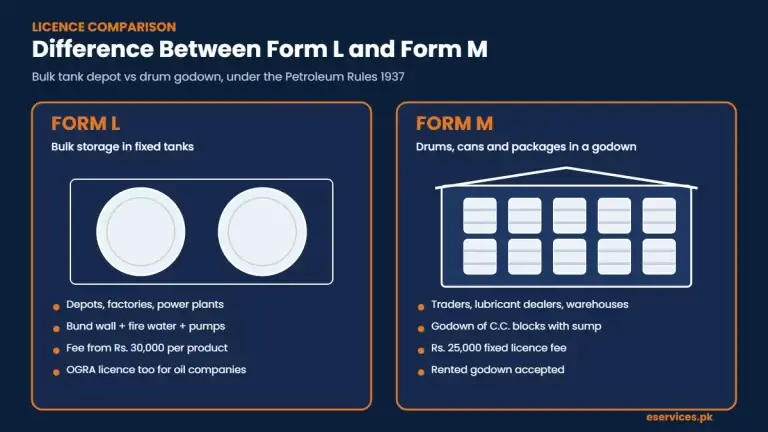
The Form L licence fee is Rs. 30,000 per product up to 500,000 litres and Rs. 80,000 per product above that, as listed in our Petroleum Rules 1937 guide. The fee is charged for each product, so a depot storing three products, for example diesel, furnace oil and a solvent, pays Rs. 90,000 (3 × Rs. 30,000). A Form M godown, by contrast, pays one fixed Rs. 25,000 for all its products: see the difference between Form L and Form M. Construction, engineering drawings, tank testing and NOCs cost far more than the fee and depend on tank size and site. Use our DPL cost estimator for a first budget, and check the land requirements for a DPL licence before you buy or lease a plot.
The mistakes that delay most Form L files are:
Related services from Excellent Services
Short answers to the questions depot owners ask us most often. For the full licence process, see our guide on how to get a DPL licence in Pakistan.
Yes. Form L covers both underground and above-ground tanks. An underground tank needs corrosion protection, leak-tight fill and vent pipes, and safe distances from the property line and any basement wall. The tank is pressure-tested before use and the test certificate goes with your application.
It depends on what the depot is for. An oil marketing company or a commercial storage depot also needs OGRA licences under the Pakistan Oil (Refining, Blending, Transportation, Storage and Marketing) Rules 2016, and OGRA expects the storage to be built before it issues a marketing licence. A factory that stores fuel only for its own use normally needs just the Form L licence from NEPSA.
The bund (dyke) must hold the full contents of the largest tank inside it, after deducting the space taken by the other tanks below the bund height. Under OGRA depot standards the average inside height is kept to about 6 ft (1.8 m), so a large tank needs a wider bund rather than a taller one.
No. You may build only after NEPSA approves your drawings in writing. Work started before approval, or built differently from the approved plan, is one of the most common reasons a Form L file is held back.
Usually several months. The District Authority NOC, drawing approval, construction, tank testing and final inspection each take time, and construction is normally the longest stage. Files with complete drawings and documents move fastest.
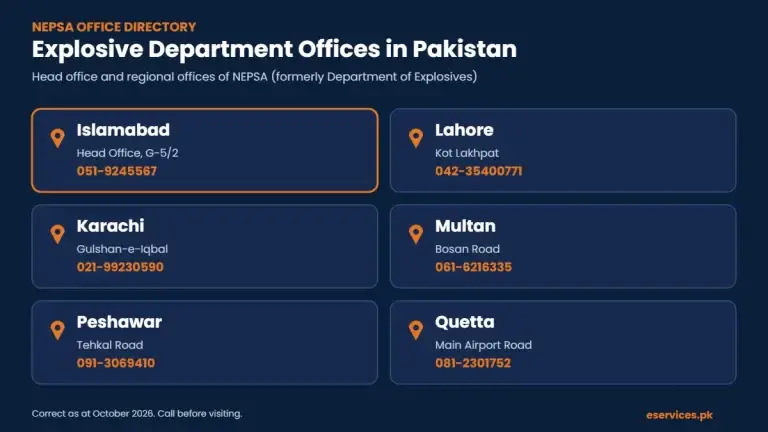
NEPSA (formerly the Department of Explosives) has its head office at the Local Government Complex, G-5/2, Islamabad, and regional offices in Lahore, Karachi, Multan, Peshawar and Quetta. Applications are filed online on the NEPSA e-portal, and the regional office inspects the site.
We prepare the drawings, get the District Authority NOC and handle your NEPSA file until the Form L licence is issued.